.png?width=200&height=40&name=Risk%20Insights%20-%20Logo%20-%20(RGB%2c%20Horizontal%2c%20Small).png)
Claims Fraud Fairness Reviews
Are some customers more likely to be flagged, investigated or declined?
- Fraud detection rules and models decide which claims your team triages and investigates.
- Rules get added and changed over the years, and the data feeding them changes too.
- If they're off, investigators spend time on the wrong claims.
- Genuine customers wait longer, and some groups may be treated unfairly.
We review the rules and models, then check claims data for impact, to determine whether there is any automated discrimination.
When it's worth checking
- You haven't yet specifically checked whether the rules and models are fair.
- Your rules or models use data like gender, age, race ro disability.
- Your rules or models use proxies like postcode, licence type or lodgement channel.
- Your board, a regulator or your team has asked whether the process treats some customers unfairly.
- Investigators say too many referrals are wasting their time.
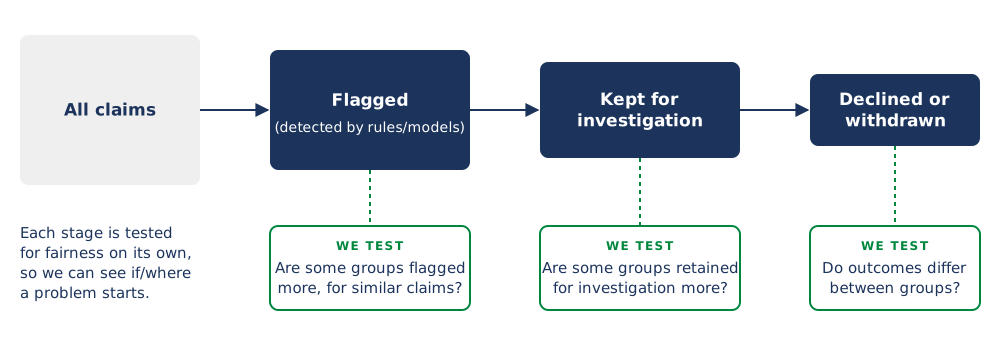
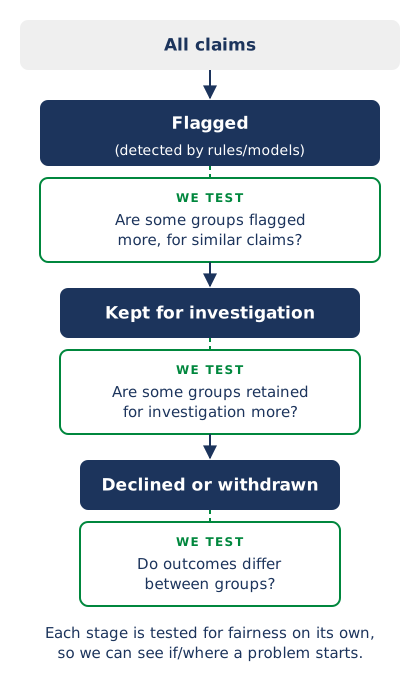
What we check
- Configuration and code: Input Data, Rules and Models.
- For protected attributes: race, gender age, disability.
- For proxies for protected attributes: like postcode, licence type, language, keywords.
- Claims data for a defined period, checking for adverse impact.
What you get
- A clear result for each test: within bounds (some gaps may be small enough to accept), outside bounds, or not enough information to say.
- Where in the models and rules there is potential for bias (regardless of the actual data).
- A short summary for your executive team, plus the detail you need to fix any issues.
How it works
- Agree the scope, the products and the analysis period.
- Understand the process, models/rules, data sources through discussions and document reviews.
- For model/rule reviews:
- Obtain relevant code and model documentation.
- Review each, in detail, to identify potential use of protected attributes directly or via proxies.
- Understand exceptions, if any.
- For impact analysis (using claims data):
- Obtain and reconcile the data for a sample period.
- Iterate until the data extract is correct.
- Determine the full period required, based on the sample, to enable a result.
- Obtain the full data set and conduct the impact analysis.
- Report the results and opportunities for improvement.
How our engagements work
- Fixed price. The typical range is $50,000 to $150,000 (AUD).
- Most reviews take 2 to 6 months.
- You work with Yusuf directly. No junior staff.
- Independent. We don't design or build the systems we review.
Common Questions
We don't hold data on race or disability. Can you still test for bias?
Yes. We test the attributes you do hold, such as age and sex. We also check whether other data is acting as a stand-in.
If you find a gap, does that mean we're discriminating?
Not necessarily. A gap can have a legitimate explanation, such as age in certain jurisdictions. We work through each result with your team.
How much of our team's time does it take?
Most of it is at the start: a data extract, and time with the people who know how the process, rules and models work.
After that, we come back with questions as results come up.
(It usually takes less of your team's time than a typical review, because the person asking the questions is experienced.)
How to get started
If you're responsible for claims, or claims fraud specifically, and want to know it's fair, book a call.
We'll talk through how your setup and whether a review makes sense.